Menu
Log in

Explore original insights and reflections from our coach members, sharing experiences, case-studies, emerging trends, and practical tools. Expand your viewpoint, deepen your practice, and engage with perspectives from within our coaching community.

  • 23 Apr 2022 12:24 PM | ICF Malaysia Editor (Administrator)

    Authored by: Law Soh Ying, Elaine

    Do you need a compelling reason to pursue coaching? Well, there must something that makes you want to do it. It may be because (a) you are seeking to be coached (if you have issues and need to work on them with someone), or (b) you want to learn how to coach and help others.

    Whatever the reason, firstly you have to understand what ‘coaching’ means. In broad terms, to coach means to help someone unlock his potential by raising his self-awareness and changing the mental frame from disempowering to empowering frame.

    I started my coaching journey with Corporate Coach Academy in the midst of Covid in mid-2020. Well, the desire to learn did not just emerge from nowhere. The uncertainties and challenges during Covid have accelerated my long-awaited move to take up coaching for the reasons I mentioned above.

    I’ve always wondered what coaching is all about. Now I know.

    As a legal practitioner, I am used to providing solutions to issues and problems. Understandably therefore, in my early days of coaching lessons it was quite tough trying to get use to the kinds of questions that a coach should only make and to the idea that a coach should focus on the person rather than the issues.

    Coaching is a powerful tool. With proper strategies, through coaching we can uproot our own belief system that no longer serve us or is holding us back from reaching our goals or life purpose, or to help others achieve their self-awareness and remove self-limiting belief.

    Sometimes it takes a triggering event that forces us to look deep within ourself and let burning questions like, “Am I doing enough?”, “Why am I feeling stuck?”, “Am I feeling fulfilled?”, “Is there something more that I can do?”, “What can I do to serve others?” push us to want to do something more or different. But will we actually take action?

    Often what is holding us back from achieving our highest potential or life goal is our own belief system or disempowering thoughts. What’s stopping us from changing or taking action that will bring us closer to our goal? Fear and comfort. We fear failure and rejection. We are too comfortable in our own current comfort zone. Coaching is therefore worth pursuing if you are looking to change or improve your life, or to help other people who are in need of help and support.

    Looking back 6 months ago and now, I have liberated myself from many self-limiting and disempowering beliefs. What I thought was not so possible, I have managed to break through them (and still in the process of more breakthroughs). Getting connected to great mentor coaches is also one of the most valuable part of the coaching journey. All these were possible due to one little step that I’ve taken – embarking on the coaching journey. Hence, do not underestimate the simple yet powerful question “What is the one little step that you can take” in order to push yourself forward and to be better.

    I can’t think of any other more compelling reason (to pursue coaching) than the benefits highlighted above. A crisis like the pandemic should not dampen our spirits in achieving our life purpose. We can still achieve much more by continuing to build knowledge and skills in areas that are new or unknown to us, including coaching. If you have the desire to thrive and build a better version of yourself, why wait and what’s stopping you?


    (This Article was published in the New Straits Times (Klassifieds) on 24 February 2021)


  • 15 Apr 2022 9:09 AM | ICF Malaysia Editor (Administrator)

    Authored by: HONG WID LEE

    I am an entrepreneur, in my journey of starting a new business,

    I experience like No time to do, no time to that. Invest the time in wrong activity, made wrong decision and spend more time on minor task, sigh! What is wrong with me…

    “Oh my god, when can I spend time with my family!”

    Earlier last year 2021, I meet two new opportunities at once about to enrolled into a business community and a coaching school. In the process of choosing either one as I thought I have no time to do both, and where I meet the coach in just a discovery call.

    I found out that my blind spot of my fear of wasting time is about don’t want to feel that I’m stupid if I made wrong decision and having to restart everything again and again. I also find out what I want to create my own version of work life balance, to equip myself with new skill and network to expand my business and do what I love in my life.

    I choose to enroll into both and take up the challenge and hoping no time is wasted…

    The journey begins, it is challenging at first, do this first or do that first?  in progress of I am being coached as well, I notice that more possibility way to generate better schedule and for myself doing more in my life!

    I am now able arrange my time properly and have time for my loved one & family when continue to create my business growth.

    Want to experience that, register with me in discovery call for a coaching session to know more.


  • 5 Apr 2022 2:35 PM | ICF Malaysia Editor (Administrator)

    Authored by: Kareen Woo 

    Fear is an immensely strong word with high negative power. Do you notice the change on facial expression of the person you say the word fear to? And when you say the word fear, your heart feels a little pressed down? It’s like our body has a special sensor for this word. Even by speaking about it, gives us a shiver.

    Our brain is wired to either freeze or flight when we confront with the emotion of fear. But, how come we react the same even though each of us fear different things? Emotions trigger reactions while incidents cause emotions. Therefore, the same reaction is triggered even though the incident that caused it can be different for everyone. Not just any incident, but one that causes deep impact to us.

    Incidents like a bad relationship may cause sad or hurt emotion while fear is caused by traumatic incident. Trauma can be caused by level of impact on us or the number of occurrences of similar incidents. For example, one bad relationship that caused us to lose a loved one (deep impact) may escalate the sadness to fear. Or if we had multiple bad relationships (many occurrences)then we may fear of relationship.

    When a traumatic incident happens, our brain works like a tape recorder to record the incident and the reaction. This is to protect us from going through that same incident again. In the future, when a similar incident happens, the brain recognises the pattern and automatically send a signal to freeze or flight. As we go through our life, we will be recording many of these events. What the brain cannot do is to reverse the recordings on its own.

    For example, when I was about 7 years old I was chased by a pack of dogs. I jumped into the monsoon drain to hide. I can clearly remember how fierce, loud and big sized the dogs were in comparison to me as a child. That incident had traumatised me and I had been scared of dogs and even puppy since then. This has stopped me from going near any dogs and in many occasion cause some accidents that injure myself.

    What I didn’t realise was my brain cannot undo this fear even though circumstances has changed. I am now in my 30s and bigger in size than the dogs. I also know how to protect myself better. But, the fear is so strong that I do not see this. Not until I reflect and have conscious awareness of the root of my fear. I also got myself peer coaching sessions and asked for my loved ones support to help me overcome this fear.

    After about 3 months time, I am now able to hold and play with puppies. I no longer run away when I walk pass a dog on the street. I believe as time passes, my brain will record my comfort around dogs and delete this fear for me.

    Here are the 5 steps to embrace and overcome fear:

    1. Understand the trigger of the fear

    What incident or event caused the fear? Try remembering the first time you encounter it and reflect on how you feel about it. Think about what your brain is trying to protect you from and why? You have to first embrace it before you can overcome it. My brain was trying to protect me from the dogs. They are bigger size and I am helpless as a child

    1. Re-assess if this fear is still valid

    Is the reason why the brain wants to protect you still valid and logical with the changes of circumstances over time? For me, it is no longer valid because I am a grown up now and I know how to protect myself. If the reason is not valid anymore, be fully aware about it.

    1. Consider the gain and opportunities

    Think about the opportunities, gains and possibilities that you will receive when you overcome the fear. This helps to motivate you and further validate that this fear is no longer protecting you. It is stopping you from moving forward. It sends a message to your brain that this can be override because it will no longer harm you.

    1. Get support

    Get people around you, family or friends to support you. My partner encourage me to touch a dog whenever we see one around us. He lets me know that they will be there if anything were to happen.

    1. Keep trying

    It takes time, give yourself the space and time you need. Move forward a small step at a time. Very soon the step will become bigger and bigger until you overcome the fear.

    To read more of my articles, visit www.passiolink.com.


  • 5 Apr 2022 2:33 PM | ICF Malaysia Editor (Administrator)

    Authored by: Kareen Woo 

    You are finally assigned to lead executives. Whether as a team lead or a manager, this is the start of more promotions and an upward career path but only if you prove yourself. Leadership is an important skill that corporate management and SMEs owners look for when they identify talents in their organisation. This article shares leadership advice for first time managers using 3Fs.

    Some first time managers may feel overwhelmed as leading another person is an additional task. They worry about how to make their direct report like them and not leave the job.

    Other first time managers think that their role now is to assign tasks and making sure the team hit their KPIs. They become very task-focused and overlook the need of building their leadership style and skill as well. The latter is more important especially if you are a first time manager.

    The 3Fs – Nurture First Time Managers To Be Leaders

    Yet, it may be too much to ask for first time managers to define their leadership style so soon. After all, you have just started to lead. Leadership style takes time to define as it is built on your authentic character as a leader.

    What can you do in the meantime? When my direct reports start leading a team and come to me for advice, I ask them to start with the 3Fs – Firm, Fair and Focus.

    1. Be Firm

    Set expectations and be firm about it. Communicate on your preferred working style and your expectations. This should cover both parties’ expectations mutually agreed to. Open communication like this also sets a very good start in building trust with your new direct reports.

    2. Be Fair

    Treat everyone the same with no special privilege. If any of your direct report makes a mistake, you should be firm and hold him / her accountable. This includes yourself. If you have an expectations on punctuality for your team, then you also should adhere to this and be held accountable if you violate it. By treating everyone equally, the team will be more open to you and share honest feedback. This is one of the ways to cultivate respect.

    3. Stay Focus

    Give your team a direction and stay focused. I have come across first time managers who are not able to manage their managers’ expectations. Therefore, agreeing to too many things until they cannot focus. When you cannot focus, your team will be running around like a headless chicken. Pace out your goals, set a timeline and direction. Communicate it to your direct reports. Once you are done with the first set of goals, you can move to the next.

    There you go, the 3Fs (Firm, Fair and Focus) to kickstart your leadership journey as a first time manager. It’s easy to remember and simple to execute. Don’t get overwhelmed by the complexity of leadership styles as you begin your journey. Build on your character and your style will follow. It takes time for you to develop your leadership style and it has to be authentically you. Not made to be but as the leader that you are.

    To read more of my articles, visit www.passiolink.com.


  • 14 Feb 2022 8:36 PM | ICF Malaysia Editor (Administrator)

    Authored by: POH SIEW HAR (Susan Poh)

    #1 It’s not easy

    Retirement creates various layers of complexities for an individual. So much more for a couple trying to figure retirement out together.

    Here, retirement coaches have a profound opportunity to anchor constructive conversations for clients, reveal the differences they are facing, help them reach some common ground, and ultimately grow closer in this next phase of life together.

    #2 Coaches need a framework for working with couples

    It’s fair to say each spouse will have preconceived notions, differing attitudes, and priorities about life in retirement.

    The couple’s coaching process entails each spouse developing an ‘individual retirement vision’.

    Next each spouse takes turns exchanging visions, and exploring where they align and where they diverge, particularly around new experiences and interests they’d like to pursue, and how much time each spouse wants to spend alone, together, and/or with others.

    Invariably, spouses can be surprised as they could be hearing certain preferences for the first time, and while these discoveries can yield unexpected insights, the goal is to create a ‘shared retirement vision’ that is flexible since life situations can suddenly change.

    #3 Questions to get couples talking more about their Individual and Combined Retirement Visions

    1. What new things do you want to learn?
    2. What do you most want to see and/or experience?
    3. What have you always wanted to do, but haven’t done yet?
    4. What are your biggest dreams, goals, and aspirations?
    5. If you had unlimited money, time, and resources, what would you want to do - alone, together, and/or with others?
    6. How can you live your life with a greater sense of meaning and purpose?
    7. What relationships, if any, do you want to strengthen (or dissolve)?
    8. Where do you want to live?
    9. What do you perceive you will gain (or lose) if you tried what your spouse is suggesting?
    10. What other ways have you had to make trade-offs throughout your relationship?
    11. What is one step you can take to move towards a win-win solution with your spouse?
    12. What would be the impact of the timing of your retirement - if you retired together, and at different times?

    #4 How to handle emotionally charged conversations

    In my experience, couples in session can start arguing when struggling to communicate.

    The key here is for the coach to remain neutral and to make room for each spouse to safely express his/her feelings and viewpoint.

    In the heat of the moment, you may want to interject and say, ‘I hear loud and clear that you’re both angry because you are not feeling heard and appreciated’.

    It’s helpful to normalize these challenges and affirm that many couples face similar issues. In fact, the Holmes-Rahe stress scale ranks retirement from work as the 10th most stressful life event. Paired with other impending changes in living conditions, it’s not surprising to encounter a momentary breakdown in communication.

    When the couple sees you are not afraid of their strong emotions and are able to guide them to process what’s going on between them, it helps build trust and confidence.

    #5 Strategies for bringing each (position) a little closer to the other

    • If the wishes of one spouse seem to be dominating the other's, it’s helpful to suggest reaching a compromise where ‘Sometimes it's your way and sometimes it's my way’. For example, the ‘homebody’ sometimes goes out for an evening with friends (cheerfully) and the ‘social butterfly’ sometimes stays in for movie night (cheerfully).
    • To foster problem-solving, it may benefit couples to set ‘communication ground rules’ such as avoiding the use of words 'always' and 'never', as these words project past actions into the future.
    • To avoid projecting blame, it’s useful to encourage the use of 'I' statements because saying 'I feel __ when that happens' or 'I feel __ when I'm not able to express what’s important to me' is a more effective way of owning their feelings.
    • For couples who aren't used to discussing difficult topics, they may find it productive to set a ‘conversation time limit’, of 5 to 10 minutes. Then taking time out to reflect on the issue. And coming back when they are ready for the next 5 to 10 minutes discussion.
    • For couples who have been together a long time, it’s important to check-in with the speaker to determine if the other spouse has heard the message as it was intended, and not to make any assumptions or rely on his/her own interpretation.

    #6 What to do if the couple remains stuck?

    The couple’s retirement coach can emphasize that there are certain topics which require ongoing discussion to work through and can also re-focus conversations on areas where there is more positive energy to be grateful and appreciative.

    However, the coach must bear in mind there may be long-standing issues between the couple and may suggest they seek couples therapy first to resolve these issues, before returning for retirement coaching.


  • 1 Feb 2022 12:11 PM | ICF Malaysia Editor (Administrator)

    Authored by: POH SIEW HAR (Susan Poh)

    Traditionally, people have approached retirement only by having invested in their careers and savings.

    Almost all retirees I have interviewed wish they had invested in themselves more. They wish they had gotten the memo on the benefits of retirement coaching, and lament having relied on their own understanding of what their retirement would look like.

    Who can blame them, when today's retirement is so different from the retirement their parents, and grandparents had experienced? Each felt to varying degrees, the sting of disappointment when expectations didn’t quite live up to reality.

    Retirement coaches know that a successful transition is tied to having a concrete, written plan that addresses everyday retirement life, such as the mental, physical, social, and spiritual, as well as, how to replace work identity, incorporate structure to daily routine and fill free time with meaningful activities.

    Dialing in to what works for them, because there isn’t one right way to retire, a retirement coach facilitates exploration beyond current thinking, and invites clients to generate ideas about how they can move forward.

    This process is exhilarating for clients because for the very first time, they are being asked questions that probe beneath the surface, questions they’ve never even thought about, then asked to write down their perceptions, thoughts, and ideas, and talk about them.

    The magic of a-ha moments gets unlocked when clients feel safe to freely express and share what is important to them as unique individuals.

    When people realize that there are things, they will lose during transition from work to home life, they can choose to take preemptive action by figuring out ways to replace those things.

    The heartbreaking truth is that people in retirement have fewer things to do, and less contact with others. Therefore, they need coping strategies to move the emotional balance to the positive side.

    Engaging in immersive activities where all sense of time is lost, provide a temporary refuge, and add a touch of joy to an existence that can at times, feel mundane. Being with a close friend, dancing, negotiating a business deal, cooking, event-planning, and singing in a choir are some favorite options.

    Because deep down we all want our lives to matter, devoting time and energy to family in need, to climate change and the environment, teaching underprivileged youths, mentoring the next generation of the workplace, and finding homes for stray animals can bring a renewed sense of purpose.

    Retirees who volunteer are more likely to form new friendships, and research has found high-quality social networks enhance health and happiness, which in turn increase longevity.

    While the idea of transformation and replacing one’s work identity may at first seem daunting, doubts are cast aside once people recognize the intensely beautiful work of art they already are. The coaching process is akin to a great sculptor chiseling the outer layers away, so the end-result is the real and vivid person inside revealed.

    When people are elevated to meet retirement on their own terms, rather than submitting to socially accepted norms, it's a real game-changer. Their renewed sense of self hits a home run in their hearts and minds. They start taking action when they discover their untapped potential, all the adventures they still want to have, and the roads untraveled. In simple terms, retirement coaching helps people to become more optimistic about their future.


  • 20 Jan 2022 8:48 PM | ICF Malaysia Editor (Administrator)

    Authored by: POH SIEW HAR (Susan Poh)

    I will be sharing in this short article what I have learned about the importance of retirement coaching. Today when we talk about retirement, we are having a lot of 'surface' conversations, meaning 90 percent of what really happens in retirement doesn’t get talked about, let alone planned for.

    And that's where we as coaches can come in and add value to our clients, by shifting the focus of retirement planning beyond mere accumulation of wealth, into making more successful transitions into retirement.

    To do this, let's imagine what happens when we get vaccinated. Something 'negative' is introduced to our bodies, so that we can build immunity over time. It's the same with clients who have received retirement coaching because they'll be going in with the right kinds of ‘tools’ which bolster and sustain them.

    The reality of retirement is that it is very stressful. In fact, retirement has been listed as the 10th most stressful life event; meaning clients can't assume everything is going to work out just because they have saved up enough money or have the right stock portfolio. Retirement coaches know that simply isn't true, things don't magically fall into place. Clients need to have context, process, and ways to normalize their thoughts and feelings. Many retirees suffer in silence because there's a disconnect, they have all this new-found freedom and time because they're no longer working, but that hasn't automatically translated to more happiness.

    Through partnering with coaches, clients' awareness gets raised so there's new insight: that retirement does not eliminate work, it 'reframes' work. So, what they've always applied at work, the skills and disciplines, must still be routinely applied at home and in their personal lives, in relationships, in staying physically and mentally sharp, being connected and relevant. Considering it all, there's A LOT OF WORK involved in retirement planning.

    As coaches, we can help clients to better understand all that and not waste the most valuable first years of retirement 'stuck' having to figure out everything for themselves. Because there's another side to retirement that can lead into depression, addiction and even suicide.  These aren't what clients are prepared for. It's not what they've heard or read about in the brochures and commercials about retirement and again, if a client doesn't have a process, a strategy or plan to replace their work identity, fill their free time, stay relevant, connected, mentally and physically sharp, they're going to be susceptible to the negatives creeping in and taking over.

    Another benefit we as coaches can offer our clients is a fresh understanding of what it means to be living longer.  A quick history lesson looking back to the 1930s where life expectancy was 62: People of that time started working when they were around 10, and working very physically demanding jobs, about 55 to 60 hours a week, so they desperately needed to transition out of the workforce at 62.

    However, in today's world, that's not the case anymore. In fact, life expectancy has gone up by 30%. That's an increase of 18 years of life, and what an incredible difference that would make, in terms of living out one's dreams!

    Life's possibilities to a client aged 62 now include having plenty of time to start a business, go back to school, volunteer, do any number of things. By this same token, clients are not at the end of their careers, they're on the brink of embarking on the best new adventure of their lives. And that's why a coach's work is so important. We are positioned to help clients see retirement from a different lens, so they can think and act differently, make better-informed decisions and have the inner strength to run the victory lap of their lives.


  • 17 Jan 2022 7:19 PM | ICF Malaysia Editor (Administrator)

    Authored by: Eric Toh

    SINAR: A Coaching Model for Leadership in the Asia Pacific

    As an executive coach based in Malaysia my observation is that there are many nuances when coaching across cultures [1]. My Coaching Model SINAR is derived from a Bahasa Malaysia [2] and Bahasa Indonesia[3] from a word which means SHINE or ILLUMINATES.

    Definition of SINAR in the Malay and Indonesian dictionaries: shine, ray, emit light, illuminate

    The model has a cross-cultural component pertinent to and has an Asia Pacific flavour to it.

    The SINAR Coaching Model enables Clients to shine by becoming the better versions of themselves as Leaders and illuminate the way for the people they lead and create an environment where their teams are motivated and are performing at their best.

    Emotional Intelligence Coaching Model Eric Toh

    S– Situation:

    In the initial stage of a coaching assignment, it is important to understand the client’s situation and circumstances.

    This will include a discovery meeting to become familiar with the client’s circumstances and reality. The client also has a role here is to stimulate self-evaluation and awareness coming into the coaching program.

    The discovery meeting will also help build rapport and set expectations for the coaching program.

    Setting up the expectations is important for the Client to understand that the coaching program will abide by the Code of Ethics and uphold the Core Values as stated in Competency 1 of the 2019 ICF Core Competency Model[4].

    While the SINAR Coaching Model is a “process model” it doesn’t-necessarily have to be linear or sequential. It is always necessary to revisit each element of the model in a coaching session, to check and re-check if the client’s situation has changed.

    During a coaching session, it is also important to explore the specific situation relevant for that particular session.

    It is important to regularly check the intent with the Client during the coaching assignment and coaching sessions as this can change as the situation for the client changes and evolves.

    This element of the SINAR model is also about having coaching situational awareness which is the ability to interpret a Client’s situation and execute coaching techniques to be effective.

    I – Intent:

    The intent is the objective or goal of the coaching assignment. That includes the long term (the central theme of the coaching assignment) and the short term (establishing the coaching agreement for every session).

    This element of the SINAR Coaching Model relates to the 2019 ICF Core Competency Model [4] About Co-Creating the Relationship: Establishes and Maintains Agreements. Essentially the Coach needs to partner with the client and relevant stakeholders to create clear agreements about the coaching relationship, process, plans, and goals. The Coach establishes agreements for the overall coaching engagement as well as those for each coaching session (i.e. intent).

    The intent is the endpoint, where the Client wants to be. The intent has to be defined in such a way that it is very clear to the client when they have achieved it. The intent usually needs to be SMART: Specific, Measurable, Acceptable, Realistic, and Timely.

    However, there are times when it might be useful to have aspirational intent that is not SMART-bound at that instance. When President John F. Kennedy announced in 1961 that his goal of putting a man on the moon by the end of the decade, it was not a SMART goal at the time. Having set the bold aspirational goal or intent, it was possible to work towards making the goal SMART. Apollo 11 landed Neil Armstrong on the moon on July 20, 1969, and he became the first man to walk on the moon [8].

    The intent could be both SMART and could also be aspirational to the Client to drive success and keep energy and motivation high.

    N – Navigate:

    The roots of Asian culture are vastly influenced by religious teachers and philosophers of the East including the teachings of Confucius, Lao Tzu, Prophet Mohammad, and Buddha. Asian values emphasize social harmony and consensus[5]. Individual initiative and individual creativity are of less importance than the willingness to merge one’s identity into the life of a company, family, or community.

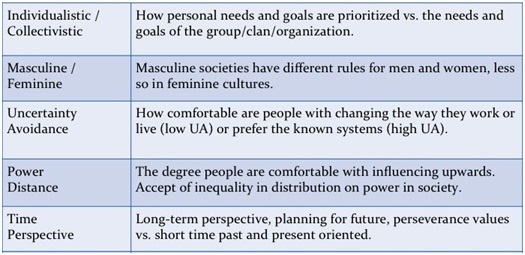
    Cross-cultural management has taken the spotlight as the business world globalized exponentially since the Cold War. Geert Hofstede [6] the pioneer in bringing cross-cultural management into the corporate world proposed the following dimensions that make cultures different in different countries on how to navigate these differences:

    1. Individualism / Collectivism
    2. Masculine / Feminine
    3. Uncertainty Avoidance
    4. Power Distance
    5. Time Perspective

    Emotional Intelligence Coaching Model Eric Toh

    This element of the SINAR Coaching Model is where navigating the Asian cultural nuances comes in. When coaching across cultures it is important to consider the cultural differences and navigate the cultural nuances and understand at least one Cross-Cultural model such as Hofstede’s model [6].

    In addition to Cross Cultural nuances, it is also important to navigate the general coaching session to evoke awareness and learning for the Client as it relates to ICF Competency 7: Evokes Awareness - Facilitates client insight and learning[4].

    A – Actions:

    No matter how great or transformational a coaching session is it cannot reach its true potential until it’s brought down to earth in terms of effective action steps that implement the discoveries and new awareness created in the session for the Client.

    Quote: "Actions Speak Louder than Words."Abraham Lincoln, 1856

    When coaching it is essential to facilitate learning into action. This element of the SINAR Coaching Model relates to the 2019 ICF Core Competency Model[4] about Cultivating Learning and Growth Facilitates Client Growth, where the Coach partners with the client to transform learning and insight into action.

    Specifically, the Coach acknowledges and supports client autonomy in the design of goals, actions, and methods of accountability support the client in identifying desired results or learning from identified action steps and invites the client to consider how to move forward toward results, including resources, support, and potential barriers.

    R – Results:

    The ultimate goal of any coaching session to ensure that the Clients get the results they want. It is essential to ensure that the Coaching Agreement is crystal clear, the goal thoroughly explored as to why it is important, what needs to be addressed or resolved, and what success looks like.

    This element of the SINAR Coaching Model relates to the 2019 ICF Core Competency Model[4] about Cultivating Learning and Growth Facilitates Client Growth, where the Coach partners with the client to transform learning and insight into action and results.

    Specifically, the Coach acknowledges and supports client autonomy in the design of goals, actions, and methods of accountability to support the client in identifying potential results or learning from identified action steps, and invites the client to consider how to move forward, including resources, support, and potential barriers.

    The Coach should ensure that both accountability and commitment factors are in place with the Client for the highest likelihood for the goal or results to be achieved.

    The Coach also celebrates the Client’s progress and successes when achieving the desired results and explores what learnings the Client gained in the course of achieving the results.

    References

    Empowering Asian Mindsets through Coaching, Wai K Leong, PCC,
    Pelanduk Publications (2008)

    Oxford English-English-Malay Dictionary, 3rd Edition, Oxford University Press (2015)

    A Comprehensive Indonesian-English Dictionary, Second Edition,
    Ohio University Press(2010)

    Updated International Coaching Federation (ICF) Core Competency Model, (October 2019)

    The Humanization of Technology and Chinese Culture, The Council of Values and Philosophy, Tomonobu Imamichi, Wang Miaoyangand Liu Fangtong (1998)

    Geert Hofstede’s Dimensions of National Cultures,
    https://www.hofstede-insights.com/product/compare-countries/

    Riding the Waves of Culture: Understanding Diversity in Global Business,
    C Hampden-Turner &F Trompenaars, John Murray Press, Third Edition (2011)

    The “Man on the Moon” Standard, M T Hansen, Harvard Business Review
    (25 May 2011) https://hbr.org/2011/05/the-man-on-the-moon-standard


  • 28 Nov 2021 9:53 AM | ICF Malaysia Editor (Administrator)

    Authored by: Jeff Cheah

    When I posted my Social Selling Index (SSI) in our LinkedIn Mastermind group recently, my SSI was 71 out of 100 (pretty good!) and a few Master-minders noticed that my Build Relationships score is 25/25 and wanted me to share my wisdom.

    I don't know what I did or do but here are some simple steps to Building Relationships that I have taken & have guided me.

    Thank You Master-minders for noticing and acknowledging my score.

    This is for you.

    Note: LinkedIn's Social Selling Index, or SSI, is a measure of a salesperson's social selling skills and execution. Statistics show that as a salesperson's social selling index rises, so does their sales success.


  • 13 Sep 2021 4:20 PM | ICF Malaysia Editor (Administrator)

    Authored by: Madhavi Selvakumar

    "Thank you for saying that”

    “Wow, I never thought of it that way!”

    “You make me so happy”

    Do any of these ring a bell? Has someone came up to you and said this? Most of us remember when we are complimented, or when we have just had a positive interaction with someone. Why?

    Is it because it made us feel good? Yes! But, is that it?

    A great conversation provides us an emotional connection. Transcending beyond the words uttered.

    The emotional connection is usually spontaneous, supportive, and unassuming.

    A powerful conversation has the strength to penetrate through the thickest walls of fear, denial, doubt, and so on. It possesses the power to transform.

    So what makes for a great conversation? Can this be developed?

    Well, one of the keys lie in one of the words mentioned above… can you guess?

    Hint: It starts with an ‘E’!

    Got it?

    I’m sure you did! Emotion! If a great conversation is emotionally impactful, then the key must sure lie there, correct?

    So the Foundational basis of our emotional state is a great starting point towards understanding how to cultivate richer conversations around us.

    Put simply: How you feel in the moment could colour your interactions with others.

    Then, here’s a thought: Does that mean the better we understand ourselves, the more grounded we feel in a conversation?

    So here’s to wishing you an emotionally great day. And to being someone’s (or even your own) bright spot today.

    Coach’s Note:

    Conversations are one part of communication that leads to powerful exchange of ideas, transformative experiences, and invaluable support. Emotions can play such an amazing role on our behaviour that they have the ability to create the spring board from which we act. Becoming aware of our emotional tapestry is a great start for a coaching experience. Words have a powerful way of making us aware of that inner world. When weaved into an impactful conversation, it ripples with potential.


Member Articles


Powered by Wild Apricot Membership Software