Menu
Log in

Explore original insights and reflections from our coach members, sharing experiences, case-studies, emerging trends, and practical tools. Expand your viewpoint, deepen your practice, and engage with perspectives from within our coaching community.

  • 30 Mar 2023 9:49 AM | ICF Malaysia Editor (Administrator)

    Authored by: Kindaichi Lee

    Hello, my fellow professionals. Today, I want to talk about the power of mindfulness practices in improving mental wellness, and how we can integrate these practices into our busy work lives. This discipline can promote shifting of mindset.

    In a world that is constantly on the go, it can be easy to become overwhelmed, stressed, and anxious. However, by incorporating mindfulness practices into our daily routines, we can learn to manage our stress and improve our mental wellness.

    So, what are mindfulness practices, and how can we integrate them into our work lives?

    Mindfulness practices involve being present in the moment and fully engaged in whatever we're doing, without judgment or distraction. This can involve techniques such as meditation, deep breathing, and mindful movement.

    One way to incorporate mindfulness into our work lives is by taking short breaks throughout the day to practice deep breathing or meditation. By taking just a few minutes to pause and focus on our breath, we can lower our stress levels and improve our focus and productivity.

    Another way to practice mindfulness is by being fully present during meetings and conversations. By actively listening to others and being fully engaged in the moment, we can improve our communication skills and build stronger relationships with our colleagues.

    Lastly, incorporating mindful movement into our workday can also have a powerful impact on our mental wellness. Taking a short walk outside or practicing yoga or stretching can help us release tension and improve our overall sense of well-being.

    In conclusion, incorporating mindfulness practices into our work lives is essential for improving our mental wellness and overall sense of well-being. By taking just a few minutes each day to practice mindfulness, we can improve our focus, productivity, and communication skills, while also reducing our stress levels and promoting mental wellness.

    Now, I want to hear from you - what mindfulness practices do you use to improve your mental wellness at work? How have these practices helped you in your career? Let's share our best practices and support each other in cultivating a more mindful and mentally healthy workplace.


  • 24 Mar 2023 11:26 PM | ICF Malaysia Editor (Administrator)

    Authored by: Jeff Cheah

    How Can Leaders Become Coaches?
    Or at the very least, adopt a coaching-leadership style in their day to day conversations?

    In 2005, Daniel Goleman, psychologist & journalist, wrote in HBR article Leadership That Get Results suggesting that there are six essential leadership styles.

    COACHING is one of them and it was shown to have a markedly positive impact on performance, culture and the bottom line.

    Question?
    With all this positive impact, why do leaders rank Coaching as the least favorite style?  From "it just doesn’t work here!" "I’m too busy", "This isn’t the best use of my time!" Or even this "The people I’m saddled with aren’t coachable!"

    My experience as an Executive Coach coaching 600 Leaders & delivering 150+ Coaching for Leaders workshops, my view is that Leaders do not have the skills to coach so they decided to take the command and control method or just provide advice coz it's the easiest thing to do. In addition, they can "show off" their knowledge.
    They think they need to know more than their direct reports.

    The good news is that all is not lost.
    Leaders who have humility, courage, discipline to change and having the mindset that "diamond lies in ordinary rocks", can certainly seek to equip themselves with simple coaching skills to be better at leading people..

    Let's explore some of the key skills that Leaders can acquire to be great Coaching Leaders.

    - Trust and Rapport - the foundation of Coaching
    - Listening - to what you do not want to hear.
    - Silence & Pause - meant to be uncomfortable
    - Powerful Questions - that can transform your life
    - Feedback - not just giving but receiving as well
    - Validation - the easiest thing you can do as a Boss
    - Self Awareness - know thyself
    - Learn - with a beginners mindset
    - Empathy - putting yourself in other people's shoes

    All these will be covered in The Leader As Coach workshop which I deliver over 7 - 8 months for People Managers.

    Here is one Organization that put through 22 of their People Managers into this Program. And Coaching is part of their KPI's.
    I can see that a Coaching Culture is going to happen soon.

    Thank You Swis Resources Sdn Bhd & Wan Zainuddin Wan Muda for the opportunity


  • 29 Oct 2022 11:03 AM | ICF Malaysia Editor (Administrator)

    Authored by: Jeff Cheah

    I am a fan of Harvard Business Review (HBR). I am now a subscriber. They write great articles on Coaching & Leadership. I enjoy reading them.

    Since I was an ICF Certified Coach in 2012 and became an ICF accredited Coach soon after that, I've facilitated over a couple of hundred The Leader As Coach program and Coaching For Leaders workshops.

    I've trained, observed, reflected on over 3,000 Leaders - First Time Managers, Mid-level to Senior Level Managers - and discovered that they are able to acquire some simple Coaching Skills, apply and practice with their direct reports & colleagues.

    And the results? It works!

    Their direct reports are empowered and made autonomous decisions, felt good about applying their own solutions to address the day to day challenges which they knew so well.

    It may look simple but it's never easy.

    First they need to be open to learn some coaching skills - building trust, asking great questions, actively listening, giving appreciation and validation, provide candid feedback, care & empathy. They need to adopt new behaviors and habits. They became aware of what needs to change. It's the courage & discipline to change that makes it viable. And be humble to admit that what they did before did not work anymore and adapt to the new routines.

    Leaders need to have a coaching mindset ie. the people working with them are resourceful, creative, capable and has the answers.
    Leaders need to learn that they don't have all the answers and their people do.

    Yes! Successful Leaders are great Coaches.
    The article started of by saying "Leadership is going through massive changes as the Baby Boomers transfer power to emerging leaders in the Gen X, Millennial, and Gen Z generations. That generational change is bringing with it a shift in leadership style, from leaders as capable managers to leaders as great coaches of people.

    And the 5 aspects that make great Coaching Leaders are:

    1. Care: Build Understanding and Trust

    2. Organize: Get People in Their Sweet Spot

    3. Align: Unite People Around a Common Vision and Purpose

    4. Challenge: Summon People’s Best

    5. Help: Solve Problems and Celebrate Success

    https://hbr.org/2022/10/successful-leaders-are-great-coaches


  • 23 Oct 2022 1:52 PM | ICF Malaysia Editor (Administrator)

    Authored by: Jeff Cheah

    This morning at MCC Live, a monthly LIVE Event by MCC's across the globe organized by ICF Malaysia, we have to honor to host Pak Heru Yuwono Liem MCC, MP, MC from Indonesia, sharing the very important topic of COACHING MINDSET.

    One of the many takeaways that I had was the acronym AJA or Advise, Judgement, Assumptions.

    I thought & reflected that as a Coach, we DO NOT AJA.
    I felt there is a missing element, the last letter and I wanted an R but I do not know what is R. So I seek google's help.

    Eureka!

    It’s A-J-A-R Advice-Judgement-Assumption-Rescue. So we DO NOT AJAR or in Bahasa Malaysia TEACH!

    I'll add this A-J-A-R to my arsenal of tools and this will be my new Mantra for 2022 when I coach Senior Leaders to shift their Telling behavior to Asking & Listening.
    And when I facilitate The Leader As Coach workshops to equip & embed Leaders with Coaching Skills and have a Coaching Mindset.

    A - ADVICE. Coaches see Clients as resourceful, capable, creative and have their own answers. Through a thought provoking process, they will discover options that works best for themselves. Our Advice is irrelevant, works best for ourselves and may not be the best for them.

    J - JUDGEMENT
    Being open, curious & interested in our clients during a coaching conversation, it’s important that we suspend judgements. Our choice of words and body language sometimes will give us away.

    A - ASSUMPTION
    ASS-U-ME. Yes, when we make assumptions, we make an Ass out of U & Me. Worst still, it’s usually wrong as we come from a very narrow perspective.

    R - RESCUE
    Our clients are not victims and not waiting for us to rescue them. They will be happy with our presence, our listening ear and our support for them to discover what’s best for them and what actions they can find for themselves.

    And there is another meaning for Ajar. It’s about us leaving an opening or a space for our clients to share their stories.

    Thank You Pak Heru Yuwono Liem MCC, MP, MC it's being insightful and I've always enjoyed your sharing - Cool, Calm, Collected and Funny as well.

    Thank you Chong SookLeng as MC, you were pretty cool too, Ranjinath Muniandy as zoom master and of course Patricia Liaw (Change Coach) for inviting Heru. I’ve always enjoyed his session - fun and relaxing!


  • 23 Oct 2022 1:46 PM | ICF Malaysia Editor (Administrator)

    Authored by: Jeff Cheah

    I was listening to a Spotify song when I came across this Album "Listening without Prejudice" which prompted me to write about our behaviors which can definitely create powerful conversations, gather more insights, learn better & grow fast. This will also create more collaboration, ensure better tolerance and foster world peace.

    So here are some that I can think of.

    Hope my Coaches friends & Coaching Leaders can add a few more
    to the list.

    1. Listening without Prejudice

    2. Asking without knowing the Answers

    3. Sharing without Expectations

    4. Observing without Assumptions.

    5. Giving Unconditionally

    6. Facilitating without Condescending

    Let's expand the list and use some of these wisdom as our mantra to practice daily.


    Photo Credits: Pexels by Amina Filkins


  • 23 Oct 2022 1:39 PM | ICF Malaysia Editor (Administrator)

    Authored by: Jeff Cheah

    I was inspired to write this article when I came across this paragraph in Gary Burnison’s (CEO, Korn Ferry International) book entitled LEAD.

    “Real attention, paid to us in real time – one-to-one, eye-to-eye, genuine, present and singularly focused on another - has become an experience of such scarcity, that when it’s given, it creates the opportunity to influence others intimately, to communicate effectively and to create in very little time an interpersonal bond that is the basis of teams making things happen they otherwise could not” It’s a very long sentence…but so insightful.

    So what is presence? The dictionary says “it’s the state of being somewhere”, “to show up”, “your demeanor or bearing”.

    As an Executive Coach, I learnt that presence is to listen without judgement, it’s having eye contact, empty your mind and have a beginner’s s mind (Shoshin) even if you think you are the expert. It’s removing all distractions including your favorite communications device. It’s about being mindful and not have the mind full. It’s not just about paying attention, it’s about giving attention. It’s about being curious, interested in the person in front of you and also keen on what he is saying. It’s seeking to understand and not to reply. It’s about observing and noticing what’s going on. Its about being comfortable with silence.

    And what will be the desired outcome?

    It creates a safe and supportive place for people to feel free to share ideas, ask questions and engage with each other. The quiet will not be afraid to speak up, the noisy ones will shut up and listen more. It fosters new ideas, creativity and new thinking. It makes people feel appreciated, recognized and respected.

    It satisfies the ultimate human desire to be seen, heard and acknowledged. People feels good, motivated and engaged when they are recognized. Recognition is the accelerator. If you not just pay attention but give attention, people thrives. Also it must be done consistently, authentically and with a genuine heart.

    Former President of USA, Bill Clinton is well known for his ability to make you feel like the only person who exists on this fair Earth while he’s speaking with you.

    In contrast, I remembered till this day an incident that happened 40 years ago when I was a rookie sales representative in IBM. I made a sales call to this large construction company and was making a sales pitch. The prospect, a Senior Manager, was working on something else and he told me to continue talking. Obviously, he was not giving me the attention. Unfortunately, being young and naive, I continued. No attention, no sale & I remembered this incident for a long, long time. It has taught me a great lesson. Give people the attention and respect no matter who they are.

    Sounds simple but it’s not easy. Start by having one-to-one conversation with people, practice silence, eye contact, shut up an listen. Say Thank You at every opportunity. Find out if the person feels better after the conversation than before. That will give you the best feedback to do better the next time.

    Emulate Bill Clinton’s listening skills, master it & you will become a great respected leader yourself!

     by Jeff Cheah, Executive Coach & Facilitator

    Credits: LEAD by Gary Burnison                                                                           

    Photo Credits Pexels by Stefan Spassov


  • 23 Oct 2022 1:34 PM | ICF Malaysia Editor (Administrator)

    Authored by: Jeff Cheah

    Listen to what you don’t want to hear.

    I extracted this from Korn Ferry’s CEO Gary Burnison latest book Leadership U ~ Accelerating Throigh the Crisis Curve.

    This is the story shared by Gary Burnison

    “Every time we have a discussion, there’s complete alignment - 100 percent buy-in.”

    It sounded too good to be true - and, as it turned out, it was.

    I can distinctly remember the interview we conducted with an executive at the start of the pandemic. When we asked him about his process for getting buy-in from his team, the executive couldn’t wait to give an example.

    “During a Zoom meeting with my team, we had a particularly important decision to make. So, I went around to everyone and asked for a ‘thumbs up’ or a ‘thumbs down’ on my idea. Before they voted, I told them that, for me, this was definitely a ‘thumbs up.’”

    “And how did that work out?” we asked him.

    “Amazing—it was unanimous!” he said. “One person’s hand wavered a little bit, but in the end, it was ‘thumbs up’ as well. It was just incredible to see 10 people on my screen - all completely aligned.”

    Are they completely aligned? Really?

    This is a common problem. When people are afraid to tell Leaders the truth, they will only say what they think the Leader wants to hear. In the case of this Executive, by giving his opinion first, he told his team that he wasn’t really interested in their feedback.

    What can you do about this?

    Be patient. Share your ideas or opinions last. Perhaps, you may not even need to share at all as your people come up with great ideas.

    As a Coach or Coaching Leader, we do believe that Diamond lies among ordinary rocks. We believe that people are capable, creative & has all the resources available to come up with their own answers.

    Are you patient enough to wait for the answer? You will be rewarded with amazing & surprising results.

    Thank you Gary Burnison what a great example!


  • 23 Oct 2022 1:27 PM | ICF Malaysia Editor (Administrator)

    Authored by: Jeff Cheah

    I came across this LinkedIn posts by Dr. Elizabeth Lindsey recently about a photo of explorers and adventurers.

    3 Powerful Words - CURIOSITY, COMPASSION, COURAGE.
    Love those 3 words. Those are the 3 words I wish to live by on a daily basis.

    Whether I am having a 1-on-1 confidential coaching conversation with a Leader; facilitating Coaching For Leaders/The Leader As Coach workshops; conducting group coaching sessions with first time or middle managers; mentoring a group of Coaches towards ICF accreditation; co-facilitating ICF Level 1 Certification or just having a conversation over coffee with my fellow coaches, mentees or family members.

    Let me start with my favorite. CURIOSITY.
    When you are curious, you are not judgemental. When you are curious, you do not give advice. When you are curious, you ask questions.
    Start with the statement "I'm curious......." when one of your co-workers come to you with a situation. Like I am curious, help me understand. Like I'm curious, tell me more.
    When you are curious, you come with a beginner's mindset and you don't have to know everything. People would love to speak up when you show a curious demeanour and display true curiosity.
    Yes, when you are curious, you are on a journey of exploration. You will be rewarded with gifts of appreciation and gratitude.
    And people will come across as H-O-T Honest-Open-Transparent!

    My No 3: COMPASSION.
    It's Empathy in action, not just putting yourself in someone else's shoes, it's also about meeting people where they are and do it with gentle care. Giving more than you take. Helping unconditionally.
    Be present. Be kind. Be considerate. Trying to understand the person or situation better. Giving the other person(s) more space. Shut up and Listen. Be comfortable with silence. Respond not react. Do not assume but seek clarification and understanding. Take more deep breaths.
    It's about experimentation for both sides.

    My No 2: COURAGE.
    Be vulnerable, it's a strength according to Brené Brown. Choose courage not comfort or complacency. Say "Yes" even if you have not done it before, even if you feel you are not completely ready. Do the dive. You will never be 100% ready.
    Your Courage will let you experience new adventures, going to places you have never been, learning and growing rapidly along the way.

    My New Mantra: Be Genuinely Curious, Be Truly Compassionate, Be Confidently Courageous. This is what I will live by starting today!


  • 20 Jul 2022 5:54 PM | ICF Malaysia Editor (Administrator)

    Authored by: Paggie Chow

    Coaching, in many ways, is distorted.

    (i can feel some coaches starting to cancel culture on me. rewind.)

    To people who do not know what is coaching, it is perceived as providing advice and solutions for the subject matter. Like a mentor, counselor, or consultant. There is a line of distinctions in each role.

    “Please give me guidance.”

    “Fix my life.”

    “Give me an answer on how to live my life.”

    If you want people to give you answers, coaching is not for you.

    Simple.

    Fitness trainer = Provides meal plan, workout plan, correct your squat form

    Fitness coach = Ask thought-provoking, reflective, powerful questions that reveal a whole new world

    Not saying that I should label ‘trainer/coach’ according to the job title, but revealing there are different styles of supporting people to move forward in life.

    Here are 5 questions the OME coach will ask:

    1. May I have your permission to share my observation?
    2. What feeling comes to you?
    3. What story do you tell yourself?
    4. What is available to you now?
    5. What support do you need to overcome the challenge?

    Regardless of trainer or coach, they deliver results.

    I am not telling you how to choose the right coach in this article, but ask yourself:

    “Why is having a coach important to you?”

    All the love and blessings to you.

    - Paggie

    p/s: OME stands for Ontology, Mindful, Ecology


  • 23 Apr 2022 12:46 PM | ICF Malaysia Editor (Administrator)

    Authored by: Law Soh Ying, Elaine

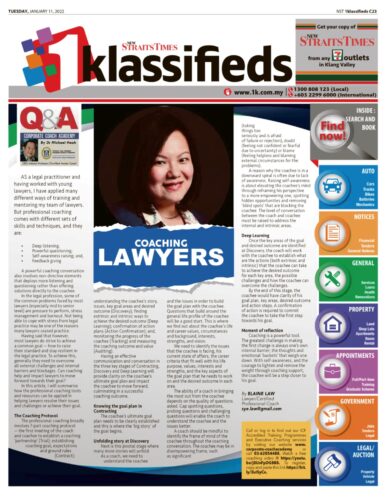
    As a legal practitioner and having worked with young lawyers, I have applied many different ways of training and mentoring my team of lawyers. But professional coaching comes with different sets of skills and techniques, and they are:

    • Deep listening
    • Powerful questioning
    • Self-awareness raising
    • Feedback giving

    A powerful coaching conversation also involves non directive elements that deploys more listening and questioning rather than offering solutions directly to the coachee.

    In the legal profession, some of the common problems faced by most lawyers (especially mid to senior level) are pressure to perform, stress management and burnout. Not being able to cope with stress from legal practice may be one of the reasons many lawyers ceased practice.

    Having said that however, most lawyers do strive to achieve a common goal – how to raise their standard and stay resilient in the legal practice. To achieve this, generally they need to overcome all external challenges and internal barriers and blockages. Can coaching help and impact lawyers to move forward towards their goal?

    In this article, I will summarize how the professional coaching tools and resources can be applied in helping lawyers resolve their issues and challenges or achieve their goal.

    The Coaching Protocol

    The professional coaching broadly involves 7-part coaching protocol - the first meeting of the coach and coachee to establish a coaching ‘partnership’ (Trial); establishing coaching goal, expectations and ground rules (Contract); understanding the coachee’s story, issues, key goal areas and desired outcome (Discovery); finding extrinsic and intrinsic ways to achieve the desired outcome (Deep Learning); confirmation of action plans (Action Confirmation); monitoring the progress of the coachee (Tracking) and measuring the coaching outcome and value (Auditing).

    Having an effective communication and conversation in the 3 key stages of Contracting, Discovery and Deep Learning will provide clarity on the coachee’s ultimate goal plan and impact the coachee to move forward, culminating in a successful coaching outcome.

    Knowing the goal plan in Contracting

    The coachee’s ultimate goal plan needs to be clearly established and this is where the ‘big story’ of the goal begins.

    Unfolding story at Discovery

    Next is this pivotal stage where many more stories will unfold.

    As a coach, we need to understand the coachee and the issues in order to build the goal plan with the coachee. Questions that build around the general life profile of the coachee will be a good start. This is where we find out about the coachee’s life and career values, circumstances and background, interests, strengths, and vision.

    We need to identify the issues that the coachee is facing, his current state of affairs, the career criteria that fit well with his life purpose, values, interests and strengths, and the key aspects of the goal plan that he needs to work on and the desired outcome in each area.

    The ability of a coach in bringing the most out from the coachee depends on the quality of questions asked. Gap spotting questions, probing questions and challenging questions will enable the coach to understand the coachee and the issues better.

    A coach should be mindful to identify the frame of mind of the coachee throughout the coaching conversation. The coachee may be in disempowering frame, such as significant (taking things too seriously and is afraid of failure or rejection), doubt (feeling not confident or fearful due to uncertainty) or blame (feeling helpless and blaming external circumstances for the problems).

    A reason why the coachee is in a downward spiral is often due to lack of awareness. Raising self-awareness is about elevating the coachee’s mind through reframing his perspective to a more empowering one, spotting hidden opportunities and removing ‘blind spots’ that are blocking the coachee. The level of conversation between the coach and coachee must be raised to address the internal and intrinsic areas.

    Deep Learning

    Once the key areas of the goal and desired outcome are identified at Discovery, the coach will work with the coachee to establish what are the actions (both extrinsic and intrinsic) that the coachee can take to achieve the desired outcome for each key area, the possible challenges and how the coachee can overcome the challenges.

    By the end of this stage, the coachee would have clarity of his goal plan, key areas, desired outcome and action steps. A confirmation of action is required to commit the coachee to take the first step towards his goal.

    Moment of reflection

    Coaching is indeed a powerful tool. The greatest challenge in making the first change is always one’s own internal barrier; the thoughts and emotional ‘buckets’ that weigh one down. With self-awareness, and the courage to lighten and remove the weight through coaching support, the coachee will be a step closer to his goal.


    (This Article was published in the New Straits Times (Klassifieds) on 11 January 2022)

Member Articles


Powered by Wild Apricot Membership Software